
Have a look at these video thumbnails:


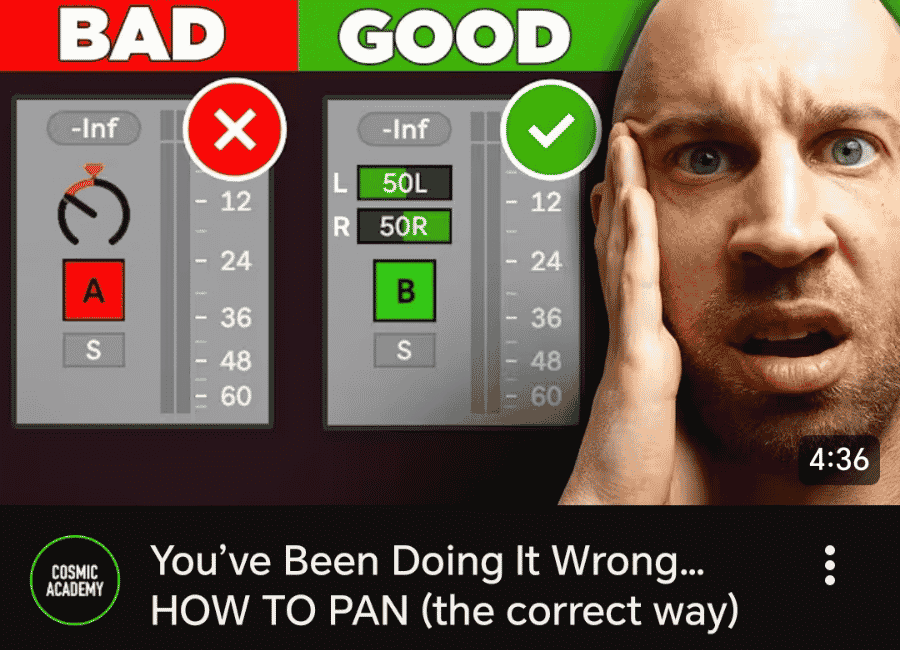

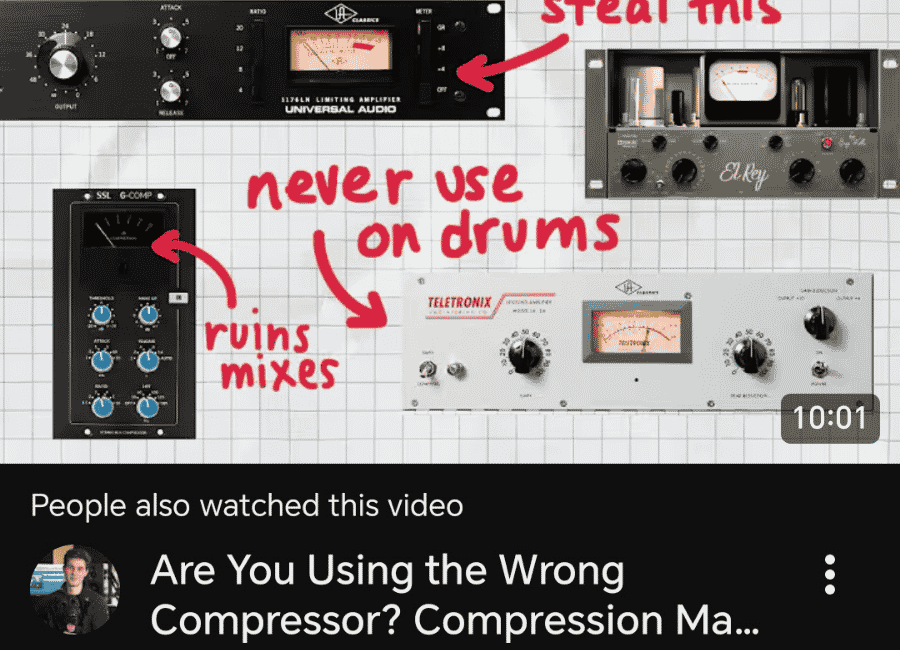
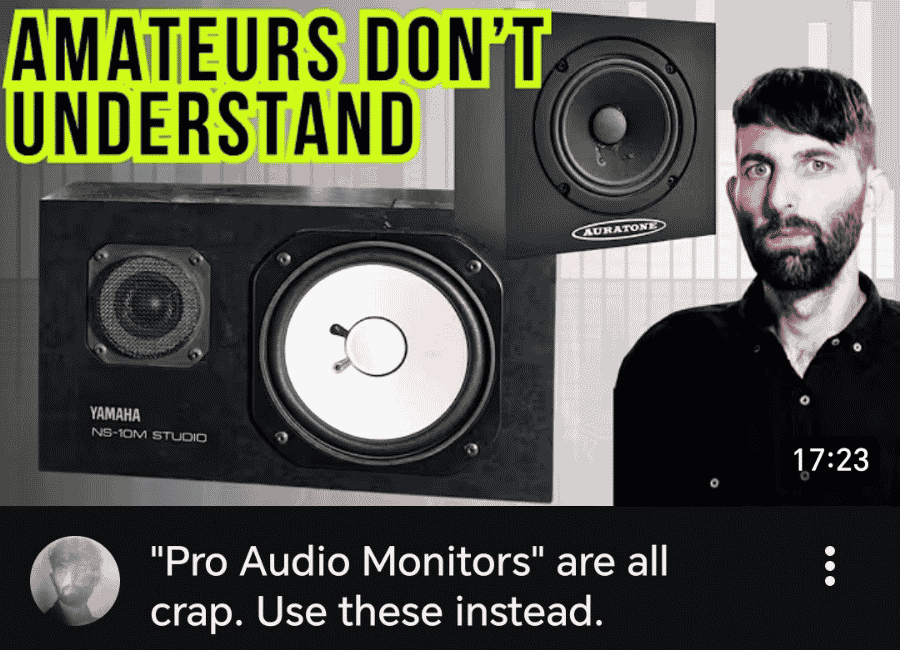
I don’t know about you but I’m feeling anxious just looking at them.
It’s exhausting how absolutist audio advice can be.
And I think it’s getting worse. I feel like I’m seeing more black and white, right or wrong types of content everywhere and in particular in music production too.
And there’s probably 2 good reasons for that:
- Music is subjective.
- Music is competitive.
Those 2 things create a hotbed for this kind of insecurity-based content. If something is subjective or lacking in certainty, then it’s very open to interpretation. We want someone to tell us there’s a formula and if you just follow the formula then you’ll be the best! Equally music production is also very competitive and there has always been a bit of a race to get to the top (quite literally, the top of the charts!).
So this kind of content “works”.
Couldn’t I just not watch?
I shouldn’t really worry, but I guess it feels that it’s becoming more and more prevalent and difficult to escape (without just switching off your phone – yeah, OK I could just do that).
In an age where it feels like our attentions have been reduced down to almost nothing, these videos and their titles have stooped lower to desperately attract what’s left of our attention – “Oh wait, oh no, this video says I’ve been doing panning wrong! (Wait, there are rules around panning? Too late now, I’m watching the video! Oh god panning! Turns out I have been doing it wrong! I’VE BROUGHT SHAME UPON MY FAMILY!)”.
So I guess if you’re feeling a bit confused or exhausted by this kind of language, then don’t worry you’re not alone. It’s all insecurities fueling others’ insecurities. And we’re all probably a bit insecure in some way so it’s hard to look away.
Why certainty is suspect
There’s a recent series of videos by Waves Audio where they put forward some statements to different producers and get them to rank them out of 10 (10 being essential and 1 being useless). They’re quite fun. Here’s one of them:
Here are some answers from different producers to the statement “Always mix with a reference track”:
- Chris Galland – “10 – If you don’t have the ability to listen to what your client is listening to, you have already lost”.
- Joe Chiccarelli – “0 – I hate reference tracks. Never will I do that. Never, ever”.
- Chris Lord-Alge – “5 – Pointless”.
Here are some answers to the statement “Checking your mix in the car”:
- Noah Glassman – “10 – Testing in the car is more about testing in a space that you’re comfortable in”.
- Joe Chiccarelli – “0 – I never check mixes in the car because I will get so neurotic”.
- Chris Lord-Alge – “10 – Always a good idea”.
Everyone has a different opinion. And that’s great. That’s the point. Music is subjective. So one person’s idea of what works, doesn’t work for someone else. So for me that means, we should tread lightly around things that say “you’re doing panning wrong!” (not sure why I’ve picked on panning, but I’m definitely going to check every single mix I’ve ever done and change the panning now).
Hedgehogs Vs Foxes
I think we need to bear in mind a few other things too. For example, good video editing doesn’t necessarily mean good advice. There’s some research to suggest this too. Bear with me…
A psychologist called Philip Tetlock spent years studying experts – the kind of people who advise governments, appear on the news and generally get treated as though they know exactly what’s coming next. In his book Expert Political Judgment, he tracked hundreds of these experts making thousands of predictions over a long stretch of time.
The results were a bit awkward. It turned out the loud, confident, high-profile names were often no more accurate than the quieter folk nobody had heard of. Actually in many cases, the more certain someone sounded, the less reliable they actually were.
Tetlock stated that there were two rough types of thinker – Hedgehogs and Foxes. The “hedgehogs” have one big idea and apply it to everything, speaking in absolutes. The “foxes” pull from lots of little bits of knowledge, stay flexible and are far happier to say “well, it depends.” The foxes, on the whole, made the better calls.
I’m not saying every confident voice in the audio world is wrong – far from it. Plenty of them know their stuff (way more than me!). But it’s worth bearing in mind that certainty and correctness aren’t the same thing. When someone tells you there’s only one right way to mix, master or record, a little healthy scepticism goes a long way. Stay curious, keep experimenting and trust your own ears. They’re usually more reliable than a confident thumbnail.
What on earth is this article saying? Just tell me what I’m doing wrong!
All in all, I guess I’m just saying, it’s OK, don’t worry about it, we’re all learning. We all get things “wrong” from time to time. But you know what? If anything really matters, it’s nice to be nice! Unfortunately though this message isn’t very socially shareable or rage baity.
Alright alright, OK, I’ll put it like this – “WHY YOUR AUDIO OPINION IS WRONG AND HOW YOU CAN BE RIGHT LIKE ME!!”